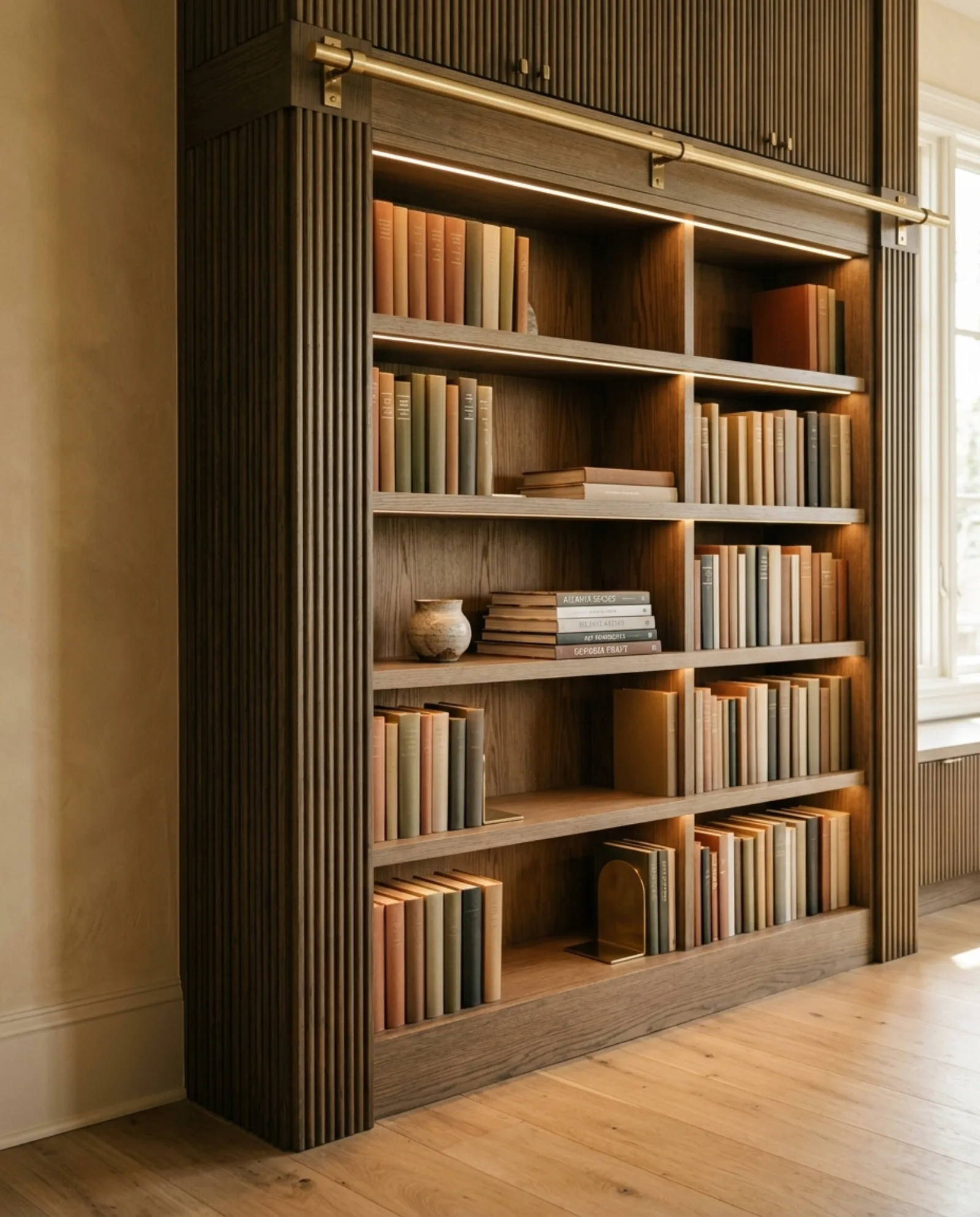
There is a clear line between a home that is well-furnished and one that is genuinely designed. The difference is not simply a matter of expenditure or even of taste. It is a matter of specificity, the degree to which the elements within the space have been conceived for that space and no other. Custom built-ins and bespoke furniture are the clearest expression of that specificity, and they represent among the most durable investments a homeowner can make in the quality of their interior environment.
In Atlanta's luxury residential market, where clients bring high expectations to projects across Buckhead, Sandy Springs, and Alpharetta, custom millwork and purpose-made furniture are not exceptional features. They are increasingly the baseline standard against which the quality of a design is measured.
What custom built-ins actually accomplish
The functional argument for built-in cabinetry and millwork is straightforward: a built-in can occupy space that a freestanding piece cannot, it can be sized precisely to the room's proportions, and it can perform storage and display functions simultaneously without the visual clutter that multiple freestanding pieces tend to accumulate.
The design argument is equally compelling. A well-designed built-in resolves the relationship between architecture and furniture by making them the same thing. A library with floor-to-ceiling shelving on two walls does not simply store books, it transforms the architectural character of the room. A window seat built into a bay defines that bay as a destination, creating a spatial experience that no placed furniture can replicate.
In Atlanta's older homes, built-ins often preserve or restore architectural details that were part of the original construction but have been lost to prior renovations. A fireplace flanked by built-in cabinetry with period-appropriate molding profiles restores a room's symmetry and sense of purpose. In new construction, built-ins provide the architectural depth that otherwise requires years and multiple renovation cycles to accumulate.
The built-in categories that matter most
Not all built-in applications have equal design impact. In Atlanta's luxury residential market, several categories consistently deliver the highest value per investment.
Library and study built-ins are perhaps the most transformative. A room lined with custom shelving, with dedicated sections for books, display objects, and media equipment, with integrated lighting above and below, with doors that conceal equipment or closed storage, reads as a finished architectural environment from the moment it is installed. The profile of the moldings, the proportion of the shelves, the choice between glass-fronted and open configurations: these decisions are where the designer's judgment has the most visible effect.
Mudrooms and utility spaces are a category in which custom built-ins deliver outsized functional value. Atlanta's family-oriented residential market, particularly in Alpharetta and other suburban communities, places high demand on entry organization. A mudroom with lockers sized for specific family members, with bench seating at the correct height, with dedicated cubbies for shoes and sports equipment and school bags, performs at a level that no retail storage solution can match.
Bedroom storage, including built-in closet systems and integrated wardrobes, is a category where the difference between custom and off-the-shelf is most immediately felt in daily use. A custom closet designed around the specific clothing and accessory inventory of its owner, with hanging sections of precise lengths, drawer configurations that match actual folding dimensions, specialized storage for shoes, bags, and jewelry, eliminates the friction that even well-organized retail systems tend to introduce.
Primary bathroom built-ins, including vanities, linen towers, and niche shelving, represent the most technically complex category because they must resolve moisture management and plumbing integration alongside aesthetic considerations. Executed correctly, a fully custom primary bathroom suite reads as a coherent architectural environment rather than a collection of fixtures and furniture.
Bespoke furniture, the case for commissioning
The market for high-quality furniture has never been deeper than it is now. Design trade sources, antique markets, and international vendors offer a range of pieces at every quality level. Yet experienced designers and their most discerning clients still regularly commission bespoke furniture. The reason is that no catalog piece, however well made, can be what a piece designed for a specific room and client can be.
The case for commissioning bespoke furniture is strongest in three situations. The first is when a room has proportional requirements that no standard piece addresses. A dining table for a specific room, for instance, must be the right length and width for the space to feel balanced. Tables are manufactured in standard sizes that may or may not correspond to the room's actual dimensions. A commissioned table is the exact size the room requires.
The second situation is when a specific material or finish combination is required that does not exist in the market. A client who wants a coffee table in a particular stone and a specific bronze finish, or a console in a specific wood species with hand-applied lacquer in a custom color, must commission that piece. The design vocabulary of a highly specific interior cannot always be assembled from available components.
The third situation is when the room will bear the weight of a single dominant piece, a bed, a dining table, a sofa, and that piece must have a presence and quality that justifies its position. A bespoke piece made by a skilled craftsperson in the appropriate materials has a quality of presence that is perceptible even to those who cannot identify its source. The hand of the maker is visible in the way a seam resolves, the way a leg meets a stretcher, the way a finish responds to light across a curved surface.
Integrating built-ins and bespoke pieces with the broader interior
The risk of commissioning custom millwork and furniture is that individual pieces can begin to read as disparate if their design language is not coordinated. This is where the role of the interior designer is most critical.
A designer working at the full-service level, developing the built-in design, specifying the custom furniture, selecting the textiles and finishes, coordinating the procurement and installation, maintains a consistent design vocabulary across all elements. The profile of a molding on a built-in library cabinet should be in dialogue with the leg profile of the desk that sits in front of it. The finish of a bespoke console table should be resolved in relation to the hardware on the adjacent built-in cabinetry.
This coordination is not automatic. It requires a designer who has established the design language clearly at the outset of the project and who maintains that clarity through the long lead times that custom fabrication requires. In Atlanta's most demanding residential projects, this coordination work is the central discipline of the design process.
Long-term value
The investment case for custom built-ins and bespoke furniture is supported by the enduring nature of high-quality craftsmanship. A well-built library with solid-wood construction and traditional joinery will outlast the home's mechanical systems, the flooring finishes, and in many cases the home itself. It does not need to be replaced as design preferences shift because its quality is fundamental rather than fashionable.
Atlanta's real estate market reinforces this. Homes with distinguished custom millwork, libraries, paneled studies, custom kitchen cabinetry, consistently command premiums that exceed the cost of the original investment. Buyers in the luxury segment recognize the difference between a room that has been decorated and one that has been designed, and they price that difference accordingly.
The decision to commission custom built-ins or bespoke furniture is ultimately a decision about the relationship between a home and its owners: whether the space will be adapted to the people who live in it or whether the people will adapt themselves to what the space already offers. In Atlanta's most accomplished residential interiors, the answer is always the former.