Atlanta occupies a distinctive position in the American design landscape. It is a city with a deep attachment to traditional Southern aesthetics, the formal living room, the covered porch, the symmetrical facade, and simultaneously one of the fastest-evolving residential markets in the country. For interior designers working at the luxury level in neighborhoods like Buckhead, Ansley Park, and Sandy Springs, navigating this duality is the central challenge and the defining creative opportunity.
Understanding current design trends in Atlanta means understanding both the roots of the city's residential character and the forces reshaping it.
The Southern traditional baseline
Georgia's residential design tradition draws from a long lineage of formal Southern architecture. The plantation-style home, the Federal-style townhouse, the Colonial Revival estate, these typologies established an aesthetic vocabulary that persists in the city's older neighborhoods and continues to influence new construction in communities like Buckhead and Brookhaven.
Within this tradition, certain interior conventions are well established. Formal entrance halls with paneled millwork, double parlors with symmetrical furniture arrangements, dining rooms with wainscoting and coffered ceilings, and primary bedrooms with sitting areas, these spatial patterns reflect a domestic culture that values ceremony, hospitality, and a sense of permanence.
At the decorative level, traditional Southern interiors favor layered textiles, antique and reproduction furniture, hand-painted wallcoverings, and a rich palette anchored by warm neutrals, deep greens, and the navy and white combinations that read as quintessentially Georgian.
This is not a static tradition. It has always absorbed outside influences, from the Anglo-Caribbean imports of the antebellum era to the mid-century modernist interventions that gave Atlanta some of its most architecturally significant residential neighborhoods. The current moment of transition is simply the latest chapter.
The shift toward contemporary sensibility
Over the past decade, Atlanta's luxury residential market has seen a significant shift in client preferences. Younger buyers and move-up purchasers are requesting spaces that retain the material richness and sense of craftsmanship associated with traditional design while shedding the formality and visual complexity that can make traditional interiors feel heavy or dated.
This manifests in several specific ways. Furniture profiles have become cleaner and lower. The carved leg and the turned spindle are giving way to tapered, solid-wood forms with restrained ornamentation. Upholstery has moved toward performance fabrics in tighter weaves that read as contemporary while remaining durable in family environments.
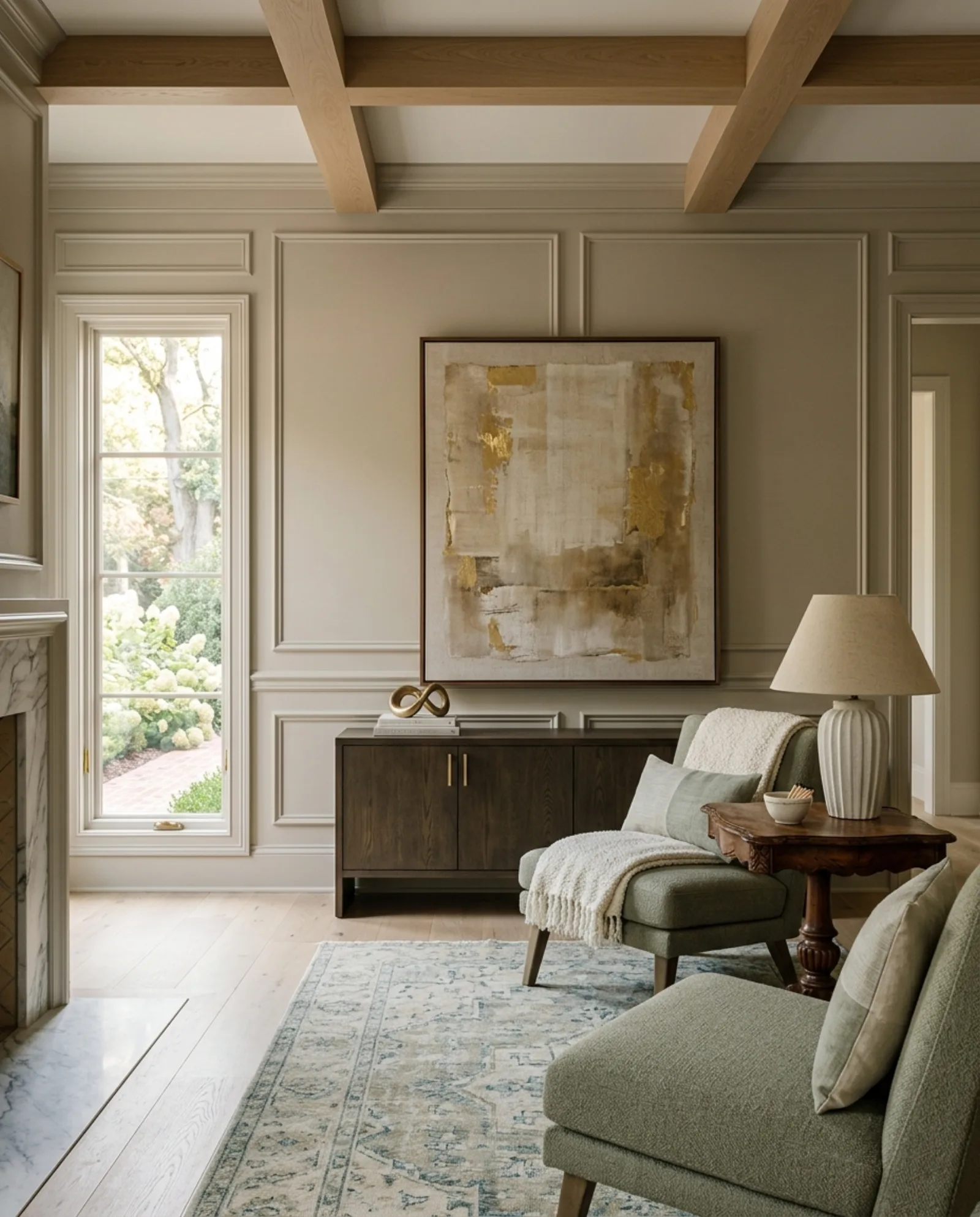
Color palettes have shifted toward a more tonal approach. Where earlier Atlanta interiors might have featured multiple distinct accent colors within a single room, the current preference tends toward rooms built around a single dominant hue, a warm greige, a muted sage, a soft terracotta, developed across materials and finishes with variety in texture rather than color contrast.
Open-plan living, once at odds with the room-by-room formality of traditional Southern homes, has become standard in new construction across the Atlanta metro area. Design professionals are now focused on the challenge of bringing warmth, definition, and a sense of intimacy to these larger, more fluid spaces, a task that requires a more sophisticated toolkit than simply selecting furniture and placing it.
Millwork as the bridge between traditions
One of the most consistent observations among Atlanta's leading interior designers is that millwork, the custom woodwork that defines architectural character, serves as the most effective bridge between traditional and contemporary sensibilities.
Traditional millwork details such as crown moldings, paneled wainscoting, built-in cabinetry, and coffered ceilings are being reinterpreted with cleaner profiles and wider proportions. A ceiling beam that might have featured an ornate carved profile in a traditional context is now more likely to be a squared, painted box beam that reads as both architectural and contemporary. A paneled library wall that once would have incorporated raised-panel doors and carved pilasters is now more often executed with flat panels, simple reveals, and integrated lighting.
This approach allows a home to carry the weight and material presence of traditional design while presenting a face that reads as current. It also ages well: a room built on good millwork bones and restrained decoration will remain relevant far longer than one dependent on trend-specific furnishings and finishes.
Material choices that define the Atlanta palette
Atlanta's climate, with its warm summers and mild but real winters, has historically influenced material preferences. Natural wood floors, white oak in particular, have become nearly universal in luxury Atlanta homes because they are warm underfoot, compatible with both traditional and contemporary furnishings, and available in the wide-plank formats that the local market consistently favors.
Stone is applied with more intention than in earlier periods. Rather than using marble or granite as a default hard surface throughout a home, designers are now selecting stone based on specific spatial and visual intent. A dramatic quartzite slab might anchor the kitchen island while a more restrained honed limestone defines the primary bathroom. The goal is for each material to be doing deliberate work rather than simply signaling a general level of expenditure.
Brass and unlacquered metals have returned to prominence in Atlanta interiors after a period in which brushed nickel and chrome dominated. Unlacquered brass, which develops a natural patina over time, aligns with the city's appreciation for materials that improve with age. It also reads as compatible with the antique and vintage furniture that frequently appears in Atlanta homes alongside new custom pieces.
Wallcovering has seen a sustained resurgence. Grasscloth, printed linens, textured vinyls, and hand-painted papers all feature prominently in the current Atlanta market. In rooms where the architectural detail is limited, a renovated space where millwork was not part of the scope, or a new construction home with minimal architectural character, wallcovering provides the layer of richness and visual interest that millwork would otherwise supply.
The role of local design identity
Atlanta's design community has developed a recognizable local identity over the past two decades, shaped in part by regional publications that have documented and amplified the work of local practitioners. The city's designers bring a specific set of references, an understanding of how light behaves in Georgia's climate, an appreciation for the specific architectural typologies that define Atlanta's residential neighborhoods, a familiarity with the local clientele's lifestyle and hospitality culture, that distinguishes their work from what a national firm parachuting into a project might produce.
The result is a residential design culture that is sophisticated, specific, and genuinely grounded in place. The best Atlanta interiors are unmistakably of this city: they have the warmth and layered richness of the Southern tradition and the spatial intelligence and material restraint of contemporary design thinking. The balance between those two forces is where Atlanta's most compelling residential work is being produced right now.
Looking forward
The next phase of Atlanta residential design will likely be shaped by several converging pressures: continued population growth bringing buyers from design-forward markets in New York, California, and the Pacific Northwest; a sustained interest in sustainable and locally sourced materials; and a growing client base that has spent significant time in professionally designed spaces and brings specific, informed expectations to new design commissions.
For design professionals working in Atlanta's luxury residential market, these pressures represent an opportunity to raise the standard of practice further, to draw more deeply on the city's architectural heritage, and to produce interiors that serve as genuine contributions to a distinctive and evolving regional design culture.